While it is true that computer security is defined as the process of preventing, controlling, and detecting the unauthorized use of any computer system , it relies on a large number of measures necessary to protect users from intruders who use digital resources with malicious intent.
That's why cybersecurity usually encompasses a wide range of security techniques worth understanding. For example, it's important to know what ICMP Tunneling is , given that it's one of the most powerful and widespread cyberattacks in this field. By its very nature, it establishes a covert connection.
Therefore, to learn how to protect yourself against this illegal activity, in this post we want to explain what ICP Tunneling is , as well as its operating mechanism in most cases. We will also explain how to react to this type of attack on any device to avoid becoming a victim.
What is an ICMP Tunneling attack and what is it used for?
Basically, ICMP tunneling is defined as an intrusion used to bypass firewalls and establish communication that is difficult to trace or eavesdrop on . A firewall , in this context, refers to the part of a computer system designed to restrict unauthorized access and allow only authorized communications.
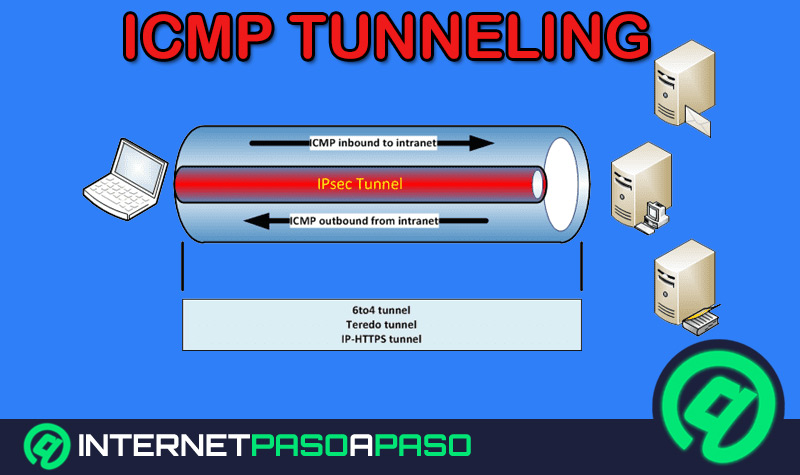
In this sense, an ICMP Tunneling attack serves to bypass computer systems that do not block ICMP packets, based on the message control protocol used to send error messages indicating that a host is unavailable . In addition, these attacks are often used to establish a covert connection between two remote machines using ICMP echo requests and response packets.
What is the mechanism of action of this type of cyberattack?
Regarding the mechanism of action of these types of attacks , or rather, how they work, we highlight that they are based on injecting arbitrary data into an echo packet that is sent to a remote computer. This machine then responds in kind, introducing an illegal response into another ICMP packet to transmit back.
Therefore, while the proxy uses echo reply packets, the client actually performs all the required communication using ICMP echo request packets . So, technically, it's possible that the proxy uses echo request packets, but these packets are not forwarded to the client because the client is behind a translated address.
Thanks to this operating mechanism, ICMP tunneling attacks can typically be used to bypass firewall rules by diverting legitimate traffic . This means that network administrators will not be able to detect this type of traffic on their network without deep packet inspection or a thorough log review.
How can I protect myself from an ICMP Tunneling attack on any device?
Given that it is extremely difficult to stop or prevent the creation of ICMP tunnels as powerful cyberattacks, because the firewall can propagate them as control messages issued by the operating system itself , supposedly; it is not so easy to protect oneself from these threats.
Therefore, to try to avoid or counteract them, it will be necessary to focus on specific security measures, which we mention here to prevent ICMP tunneling:
- It is necessary to allow passage of the large size of ICMP.
- It is useful to admit administrators the fact of use ICMP messages freely.
- Also you can choose perform strong authentication and encrypted payload.
- It should work when The computer is located behind a personal firewall. at the application level.
Therefore, it is essential to understand that it is crucial to ensure compliance with all these rules, both when the ICMP packet is uploaded to the network stack and when it is downloaded from it . Furthermore, this policy should also be implemented in the kernel 's ICMP protocol execution.